Search This Blog

Showing posts with label history. Show all posts

Tuesday, March 5, 2013

McSwain guitars

McSwain guitars, functional art

Never heard of McSwain guitars? Neither did I. No wonder; McSwain guitars is a very small, private Los Angeles USA based company, founded by Stephen McSwain. No mass production; McSwain guitars are all "Custom Shop ordered" built. His guitars are a mix between art and guitar, or as McSwain himself calls it: functional art.
It's difficult to describe the guitars built by Stephen McSwain as there is no standard range or series of guitars. You have to take a look at McSwain guitar pictures to get an idea of the individuality of each McSwain guitar. To confirm the unique, "arty" character of his guitars, Stephen McSwain creates his functional artworks in his so called "laboratory" (instead of an ordinary workshop), a converted garage in the heart of Los Angeles.

mcswain guitar body
mcswain guitar body

McSwain guitars, owned by the happy few


McSwain guitars are no ordinary looking guitars; they just scream for attention, and maybe that's why there are some, not so ordinary, guitar players around, who are in the possession of a McSwain guitar. Some of the names: Slash, Tak Matsumoto, Steve Vai, Steve Jones and Tommy Lee. McSwain, on his website, pictures the guitars he built for his clients and tells about the the building process.

The first guitar McSwain built. (carved faces in the wood), carries no. 001, and is owned by Steve Vai. One of McSwain's latest projects was a surprise gift from a couple of friends, for Duff McKagan. This guitar was built in collaboration with "Chrome hearts", and is loaded with Chrome Hearts sterling silver crosses and pluses.

It appears that the building process of one McSwain guitar can take up to several weeks, so production, in term of numbers is limited, which makes these McSwain guitars very rare. Original, second hand McSwain guitars can't be found. Fretted Americana , linked as "friend" on McSwains website, has a "Budweiser" McSwain 2011 on sale for 10.000 USD; it's the only McSwain guitar for sale, as far as I know. Fretted Americana has information about the number of guitars Stephen McSwain produces: less than twenty-five guitars per year.

mcswain guitar headstock

MacSwain by OLP and Cort


With prices starting at 5000 USD, and the fact that McSwain produces less than twenty-five guitars per year, his guitars are only available for a few lucky guitar players / collectors. There are other options though. McSwain collaborated with Cort Guitars and OLP Guitars, to put some models in the market with the McSwain Guitars authentic look and feel, factory made, at affordable prices.

OLP Guitars, Officially Licensed Products, produced replicas of famous models from other guitar builders. OLP guitars were built in China, with hardware and electronics (probably) made in Korea and doesn't exist any more. Fore some period, McSwain Tin Top / Machinery and Anarchy models were manufactured by OLP. These McSwain / OLP Tin Top (metal) top guitars can easily be found on the internet. They are for example listed on Ebay for prices around 300 USD (used) and 650 USD (new).

In 2011, Cort Guitars came out with the McSwain Gasoline 1 and Motor Oil 1 electric guitars, inspired on the McSwain Fuel Guitar, based on vintage gasoline and oil drums. The main difference between the McSwain Gasoline 1 and Motor Oil 1, besides the graphics on the guitars, is the way the neck is mounted to the body.
The Cort McSwain Gasoline 1 has a set-in neck, and the Cort McSwain Motor Oil 1 comes with a bolt-on neck. Both Cort McSwain guitars share the same (aged) hardware and a black satin finish.
At present, Cort Guitars only offers the McSwain Gasoline 1 with ClassicRocker pickups.
Next to the Cort McSwain electric guitar models, Cort produced the McSwain Motor Oil 2 and Gasoline 2 acoustic guitars with Cort piezo pickup. These acoustic electric McSwain Corts can't be found anymore on the Cort website.

mcswain guitar fuel
mcswain guitar fuel

McSwain miniature guitar (as seen in Guitar Hero 5)


Guitar Hero 5, released in 2009, featured several McSwain Guitar models. To celebrate, Stephen McSwain decided to offer a limited edition of miniature McSwain's, modeled after the originals, and the ones featured in Guitar Hero 5. A must have for McSwain and Guitar Hero 5 fans.

These McSwain miniature guitars can be obtained at bigcartel.com, a shopping cart for artists. Four Miniatures were for sale; the Flame, Anarchy, Machine and Life McSwains. The Flame miniature is sold out, and as a result, the McSwain miniature Collection is sold out. The miniatures available are on sale for 29.99 USD; a mini price for an authentic McSwain mini guitar!

mcswain guitar
mcswain guitar

McSwain Guitars

Monday, February 25, 2013

Trussart guitars

Trussart guitars; all steel hollow body

In my last post I wrote about "metal top" guitar builder Zemaitis, and the Greco Zemaitis. When surfing the internet for metal top guitars, I stumbled upon a full metal guitar, built by James Trussart. So there's more than just a metal top. Like the Zemaitis, James Trussart puts a lot of craftmanship in the unique building process and the different finishes of his guitars; they are stunning! 

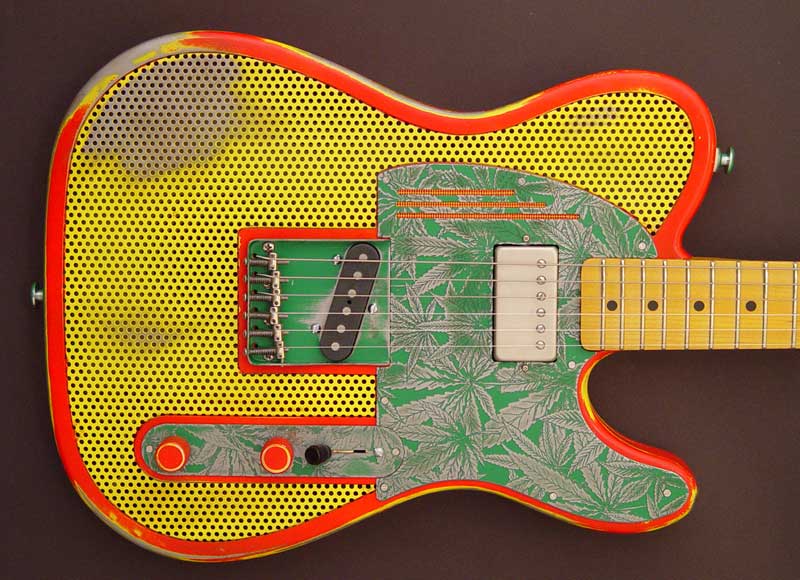
trussart steelcaster ganja

James Trussart, Rust-O-Matic


James Trussart is a Los Angeles USA based guitar builder. In the USA, Trussart's name is well established, but in Europe, Trussart guitars are relatively unknown. Trussart guitars almost have a cult status in the USA, and lot's of famous guitar players / bands (for example: Smashing Pumpkins, Pearl Jam, Aerosmith, ZZ-Top, The Black Growes) have been pictured with one of Trussart's guitars. James Trussart primary works with metal as the base material for the hollow bodies and the headstocks of his guitars. To make his guitars look and feel like a vintage instrument, the metal is for a period of time exposed to the elements and then treated to stop the "rusty" process. As shown on the pictures, the metal bodies, as well as the pickguard or headstock are imprinted or engraved. The Trussart bodies finally are sanded and clear satin coated.
The only wood used on a full metal body Trussart guitar can be found in the neck / fretboard, where the common woods like Maple, Rosewood, and Ebony are used, and in the wooden block mounted under the bridge of a Trussart guitar.

trussart steeldeville barbwire

The full metal body Trussart guitar models


In contrast to the progressive, unique building technique and the material used, The Trussart guitar models are far from unique; as far as I can see, all full metal body Trussart models can be reduced to Les Paul and Telecaster copies. The Les Paul shaped Trussart goes under the name Steeldeville, and the Telecaster shaped Trussart carries the name Steelcaster. Trussart also offers the Steelcaster  in a DeLuxe version with one F-hole in the body. The attraction of the James Trussart guitar can really be found in the techniques and materials used, and in the perfection of the finish and sound, rather than in the shape of the instrument!

trussart steelcaster roses

The metal top Trussart guitar models


Apart from the full metal bodied Trussarts, James Trussart also builds metal top guitars. Metal top guitars are less rare than full metal body guitars. The Trussart Steeltop, Les Paul shaped, can well be compared with an original Zemaitis (also in price...). The other Trussarts steel tops, the Steelmaster and Steeltelemaster, and the Steelx have, like the Trussart Steeltop, a chambered wood body, and a recessed steel headcap. 

trussart steeldeville china

Hardware on the Trussart guitars


At present, Trussart guitars are equiped with Arcane Inc. pickups and single coils. Arcane Inc. was founded in 1990 by Rob Timmons and is located in California USA. All Arcane pickups are hand wound, and are considered one of the best in the industry. Arcane (Rob Timmons) is also a consultant for guitar companies who are searching for better tone and the best pickups for their guitar. I'm not sure in what year the relation between them was established; I read a review about a Trussart guitar from 1995, and they were talking about Seymour Duncans. Anyway, all reviews I read about James Trussart guitar, state that the Trussart guitar sounds incredible.
As for the rest of the hardware, Trussart plays safe: Tune-O-Matic bridges, optional Bigsby Tremolos, Kluson Tuners, nothing weird, all gear used by premium guitar builders!

Saturday, February 16, 2013

Greco Zemaitis

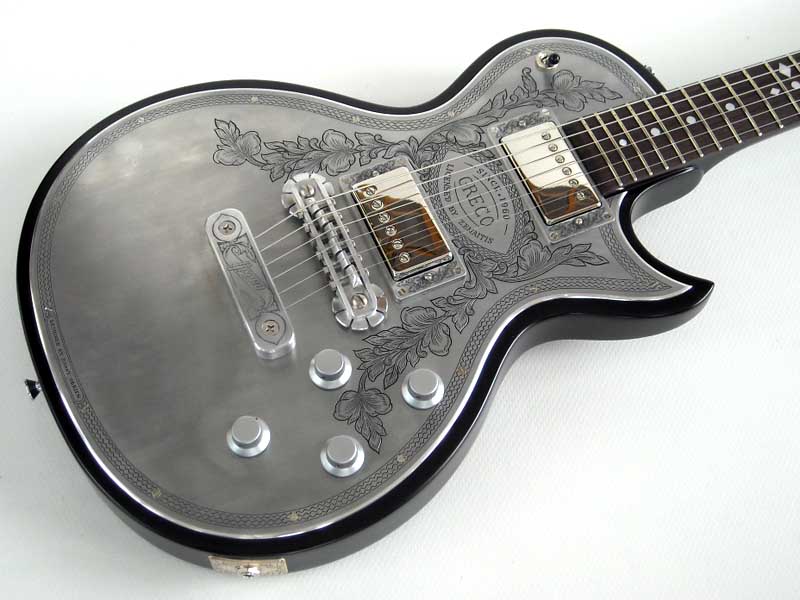
Greco Zemaitis, metal top

"Normally", a guitar is made of wood. Solid wood, laminated wood, all kinds of wood. Guitars made of other materials are "rare", eccentric, special, and in most cases, technical masterpieces and a feast for the eye. One of these other materials is metal, mostly used for the top of the guitar, and often engraved as part of the "theme" of the guitar. Some artists specialize in engraving these custom made metal tops, like for example Phil Cooper from engravedguitars.com. Other artists / luthiers take the whole picture; they actually build the guitar and provide it with a unique metal top. Guitar builder Tony Zemaitis was one of them.

greco zemaitis black top


Zemaitis guitars, some history


Zemaitis guitars was founded by Tony Zemaitis, born in 1935 in London England. In his younger years Zemaitis was trained in cabinet making, and actually build for some years high quality furniture. As Zemaitis started to play guitar, he didn't have the funds to buy a decent guitar. Zemaitis borrowed a guitar, and using his skills, made a copy of the guitar. After this one he build more guitars, improving the guitars and his skills.
This eventually lead to the building of, in that time, "rare" 12 string guitars in the 1960's. Zemaitis name was established, and in 1965 Zemaitis became full time guitar builder. Zemaitis made guitars until he retired in 2000.
Zemaitis became famous with his engraved metal top guitars and his pearl inlayed top guitars. Zemaitis guitars were played, and collected by some famous guitarists like Ronnie Wood, George Harrison, Eric Clapton and Peter Frampton. Although Zemaitis was a master in making the guitar "look good", he never did any concessions to the purpose of the guitar: his guitars should play and sound great. Tony Zemaitis passed away in 2002.
Fortunately, Zemaitis legacy lives on in Zemaitis International, founded with the support of his wife and son, and Zemaitis friend and co-worker and engraver Danny O'Brien.
Lot's of information about Zemaitis and his guitars can be found on the Zemaitis guitar owners club website.

greco zemaitis black head

Greco guitars. some history


Greco Guitars is one of the famous Japanese guitar builders. Founded in Japan in the early 1960's, Greco at first built original, "non copies" guitars in the FijugenGakki plant. With the increasing popularity of, mostly, American guitars and models in the 1970's, Greco started to make clones of the originals: Fender's, Gibson's, Rickenbacker's, Ibanez's, and yes, also Zemaiti's. Around 1974, the quality of these copies made by Greco was excellent. Due to the sublime quality of the Greco guitars made in the late 1970's and 1980's, some Greco guitars are very vintage and collectible. Japanese guitar builders like Greco and Tokai have a good name when it comes to quality.
Greco guitars are still in production today; the current series is the Greco Zemaitis, licensed by Zemaitis International.

greco zemaitis top detail

Greco licensed by Zemaitis


Zemaitis International, Tony Zemaitis's legacy, currently runs 4 series: the Custom, Acoustic, Bass, and GZ (Greco Zemaitis) series. The original Zemaitis metal and pearl tops are highly collectible, as they were not produced in large amounts. No wonder the Zemaitis guitar owners club warns for fake, counterfeit guitars.
The Greco Zemaitis doesn't come cheap, but compared to an original metal or pearl top Zemaitis, for reasonable prices, considering the work and craftmanship which has been put into the guitar. I especially like the metal tops, as pictured in this post, but also the pearl inlayed tops are true masterpieces.
Greco has a long history in building quality guitars, and in my opinion, Zemaitis International did well in choosing Greco as a partner for their "budget" series. The popularity of Zemaitis in Japan even resulted in the building of the Zemaitis Museum, where lot's of Zemaitis guitars, two of Tony Zemaitis's cars, and personal items are on show. All part of guitar history!

greco zemaitis red head

greco zemaitis red back

Friday, January 18, 2013

Danelectro Dano

Danelectro Dano pro 1959 reissue

Danelectro (Dano), built some extraordinary guitars. All these Danelectro Dano guitars have been put in the market at affordable, budget prices. That doesn't mean Danelectro Dano guitars are cheap, crappy guitars; the Dano's are well built, and often reviewed "well worth the money". I was surprised to see that, despite the fact Danelectro Dano isn't a "grand" guitar brand, the Danelectro's have a large number of fans.
It's obvious, Danelectro surprised the world with some great guitars, each with unique looks, some with humbuckers, but almost all with the eyecatching lipstick pickups. One of my favourite Danelectra Dano models is the Dano Pro 1959.

danelectro dano
danelectro dano

Danelectro, Dano, some history 


Danelectro was founded in 1947 by Nathan Daniel, who started in 1934 building amplifiers for Epiphone, which lasted till 1946. At that time, Epiphone was pushing Nathan Daniel to only build amplifiers for them. To stay independent, he started Danelectro. Danelectro, continued building amplifiers, and in 1954 Dano also started building guitars. In the years after, Danelectro build guitars under their own name, but they also produced guitars on request for sellers like Sears, who sold the Danelectro Dano guitar under the Silvertone brand.

In 1960 Danelectro was sold to MCA (Music Corporation of America), and in 1969 the Dano plant was closed as a result of mismanagement.
For some period in the late 90's till 2001, Evets Corporation sold copies of the early Danelectro Dano and silvertone guitars. From 2006, the Evets Corporation focuses on building effect pedals for guitars, but, in limited numbers, they market some guitar models, based on the old Danelectro "vintage" models.
The 2007 Danelectro Dano Pro 1959 reissue is one of them.

danelectro dano
danelectro dano


The original Danelectro Dano Pro 1959


The Danelectro Dano 1959 Pro was introduced in 1959, and has been produced until 1963. The original Dano 1959 Pro is a relative small guitar, 3/4 scale, with only 17 frets, and due to the shape of the body, the higher frets are hard to reach. The shape of the guitar and the pickguard are fairly unique, it's difficult to describe, but the pictures (from the 2007 Danelectro Dano Pro reissue) tell it all. Like most unusual guitars, you either love them or hate them. In the case of the Danelectro Dano 1559 Pro, I think it's an icon of it's time.

In 1959, the Danelectro Dano Pro came with just a single lipstick pickup. This unique lipstick pickup is a single coil pickup, with all electronics packed in a chrome metal tube. Originally, this tube came from the cosmetics, lipstick industry. Danelectro became famous with it. The lipstick tube fits the Danelectro Dano 1959, and all Danelectro Dano's from that period very well, and makes the Danelectro Dano's easy recognizable. The lipstick pickups have a kind of "twang" in the sound, and are very suitable for creating the "surf" and rockabilly" sound.

danelectro dano
danelectro dano 

One other part of the Danelectro Dano 1959 Pro which makes the guitar easy recognizable is the "coke bottle headstock". This type of headstock was also used on other Danelectro Dano's. As much as I dislike the headstock from another "vintage" guitar, the (Danelectro) Silvertone 1448, amp in a case, pictured in my previous post, I sure like the coke bottle headstock on the Danelectro Dano 1959 Pro.

danelectro dano
danelectro dano 


The 2007 Danelectro Dano Pro 1959 reissue


In 2007 the Danelectro Dano Pro 1959 reissue was presented. The Dano reissue shares the same body shape as the original Danelectro Dano Pro, but some major improvements have been made to "modernize" the guitar. The Danelectro Dano reissue has a full scale, 19 frets neck, instead of the 3/4 scale of the original. 
Furthermore the Danelectro Dano reissue is equipped with 2 lipstick pickups, for more difference in tones, and last but not least, the old fixed bridge of the original Danelectro Dano1959 Pro has been replaced by a modern fully adjustable bridge on the Dano 1959 reissue. The Danelectro Dano 1959 Pro reissue has the vintage looks of the original, but has grown to a modern mature guitar.

danelectro dano
danelectro dano 

Sunday, December 30, 2012

Silvertone 1448, amp in case

Silvertone 1448, amp in case, by Danelectro


silvertone 1448 guitar and amp in case
Sometimes I wonder why some original ideas have not been followed by others. One example is the concept of the changable pickups of the Ampeg Dan Armstrong in my previous post; in my opinion a brilliant idea, but it's not on a large scale embraced by other guitar builders, probably to expensive. Another example is the "amp in the guitar case", in this "case", the Silvertone 1448 amp in a case". One guitar, one amp, all in one case, brilliant!

The Silvertone 1448 is not the only guitar which came with the amp in the guitar case, for example Airline also produced guitars with the amp in the case in the same period, but the Silvertone models like the 1448, pictured in this article, are most known.


Sears and the Silvertone 1448 amp in case


Like the other Silvertone guitars, the Silvertone 1448 amp in case was sold by Sears (Sears-Roebuck, a chain of department stores) in the USA. Silvertone was, since the 1930's, the Sears house brand for electronics, and the Silvertone name became famous with the Silvertone radio and the Silvertone (1448) guitar. The Silvertone guitars were popular among beginners and young guitarists as they were, compared to major brands, "low cost" guitars. Especially the short scaled 3/4 sized Silvertone 1448 amp in case with 18 frets, model sold in 1962, which came with an instructional vinyl record, was young beginners material. Everything you need to start playing guitar, in one package.

In the 40's and 50's, Silvertone guitars were played by blues guitarists like Muddy Waters and Arthur Crudup. In the Silvertone 1448 era, Chet Atkins, Bob Dylan and James Hetfield were among the guitar players who's first guitar was a Silverstone.
On stage, the Silverstone was played by Mick Jagger (Rolling Stones), Melissa Ethridge and Pete Townsend (The Who), who smashed the Silvertone on stage.

silvertone 1448 body and neck

silvertone 1448 body with lipstick pickup


Silvertone 1448 and 1449 amp in case by Danelectro


The Silvertone 1448 and 1449 amp in case, sold by Sears, were produced by guitar and amp builder Danelectro. In 1954 Danelectro started building solid body guitars under the Silvertone name for Sears. They also build the same guitars under other names for other sellers. The Silvertone 1448 amp in case, pictured in this article is the Silvertone / Danelectro 1962 model.

The Silvertone / Danelectro 1448 only has one "lipstick" pickup, and the amp in the case of the Silverstone 1448 is a 3 watt amp with 3 tubes, 5 inch speaker and a gain control.

The more "mature" Silvertone / Danelectro 1449 - 1963 model has 21 frets and 2 lipstick pickups. Also the amp in the case of the 1449 is more mature: 5 watt, 3 tubes, 8 inch speaker, and more controls.

The concept of the Silvertone / Danelectro 1448 / 1449 amp in case in combination with the age of the guitar makes it very vintage and collectable! I really like the combination of the tube amp in the guitar case and the vintage body with the sleek lipstick pickup, but I can't remember ever having seen a guitar headstock as ugly as the one from the Silvertone 1448 amp in case!

silvertone 1448 headstock
silvertone 1448 headstock back and tuners
silvertone 1448 headstock tuners

Friday, December 21, 2012

Ampeg, Dan Armstrong - plexiglass guitar

Ampeg, Dan Armstrong  - Plexiglass, "See through" guitar 

In 1969 Ampeg, known for its amps for guitars and bass guitars, together with guitar builder Dan Armstrong, presented their plexiglass guitar at the NAMM show in Chicago. It was one of the highlights of the NAMM show that year, as it was the first plexiglass guitar ever. Soon after, the Ampeg Dan Armstrong (ADA) was widely known as the "see through" guitar. The guitar was produced from 1969 - 1971, and several famous rock guitarists played the Ampeg Dan Armstrong, boosting its popularity. Between 1998 and 2001, the ADA, again for a short time, was produced in Japan. More than 40 years after the introduction of the original, the "see through" guitar still looks revolutionary. Since 2006, the plexiglass Ampeg Dan Armstrong is produced again; the same futuristic look, but with some significant changes.

ampeg dan armstrong plexiglass body

The original concept of the Ampeg Dan Armstrong


Dan Armstrong intended to build an electric guitar with excellent sustain, and came up with the idea of using plexiglass for the body of the guitar because of the rigid qualities of the material. Apart from the plexiglass body, the Ampeg Dan Armstrong has more innovative features. One of them is the presence of two strap-buttons on the body, which makes it possible to easily stand the guitar upright, still pretty unique. In my view, the main feature, besides the "see through" body, is the possibility to change the pickups by sliding them in and out the body, and connect them with two plugs. The original ADA gave the choice between 7 single coil pickups, designed by Arstrong and Bill Lawrence! A great idea, and I wonder why other guitar builders didn't "pick up" the concept.
The plexiglass body of the Ampeg Dan Armstrong is somewhat thinner than the average electric guitar body, but still, the guitar is relatively heavy, around 4,5 kg.
One of the main problems of the original design was tuning instability. The way the neck was bolted to the body, "clear off", using large bolts, resulted in less wood in the "tongue " of the neck, which caused the problem.

ampeg dan armstrong plexiglass pickguard


The "new" Ampeg Dan Armstrong, major improvements


To resolve the tuning instability issues, the latest Ampeg Dan Armstrong has a new neck joint, with smaller screws, mounted on the back of the guitar, combined with high quality Grover tuners. With the original ADA equiped with 7 pickups, the new Ampeg Dan Armstrong only has 2 exchangeable pickup, so the original versatility is limited. Like the ADA's produced in Japan between 1998 - 2001, the pickups are designed by Kent Armstrong, Dan's son. Both pickups, one single coil Rock Treble, and one Sustain Treble humbucker, are huge; the room is needed for the large gauge wire, according to Kent Armstrong, used to create better tone.
Last but not least, the neck profile returned to the original profile, instead of the slimmer neck profile of the Japan made ADA's. 

ampeg dan armstrong plexiglass headstock

The Ampeg Dan Armstrong in the "Rock Scene".


Lot's of rockers were, and still are, happy to be seen with a "see through" Ampeg Dan Armstrong. From the original ADA, played in 1969 by Rolling Stones' Keith Richard and Bill Wyman, Leslie West and Paul McCartney, to the latest version, used by the Foo Fighters and the Red Hot Chili Peppers. The plexiglass Ampeg Dan Armstrong hasn't lost any of it's attraction.

ampeg dan armstrong plexiglass body back

ampeg dan armstrong plexiglass pickup

Friday, November 30, 2012

PRS Dragon, "dragon" inlay fretboard

PRS Dragon, Series I, II, III and 25th anniversary

Some guitars are considered to be "art", and actually, there are guitars which can be found in museums. In this case it's not about playability, but it's all about craftmanship and design, guitars built by masterbuilders with the skills of an artist / designer.
One of those guitars to be considered "art" is the PRS Dragon with it's design and inlay of the fretboard.

prs dragon series I fretboard inlay closeup

PRS, founded in 1985 by Paul Reed Smith, has the PRS Dragon exposed in the Smithsonian, the National Museum of American History. Also the PRS Dragon is supposed to be in the collection of the MOMA, the Museum Of modern Art, but I can't find any information about that on the MONA website. The guitars were donated by PRS, and it gave a boost to the collectability of the PRS Dragon. From here, the success of PRS Guitars started.

The PRS Dragon is handbuilt, in the early years of PRS Guitars, and is considered to be far more superior than the guitars built in the PRS factory, which was established in 1995.

prs dragon series II

PRS Dragon, Series, building years and limited numbers


Like most collectible guitars from a Custom Shop or (PRS) Private Stock, the limitation of numbers built is essential. The PRS Dragon is no exception. The PRS Dragon is not as rare as "single pieces", but still rare and expensive enough to be collectible. Most PRS Dragon's will be in private collections.

The PRS Dragon Series I was built in 1992, limited to 50 Dragon's.
The PRS Dragon Series II was built in 1993, limited to 100 Dragon's.
The PRS Dragon Series III was built in 1994, limited to 100 Dragon's.
The PRS Dragon 25th Anniversary, limited to 100 Dragon's.


PRS Dragon, fretboard / neck inlay


Obvious, the fretboard "dragon" inlay is the main feature of the PRS Dragon series I, II and III. The work is done by hand, which takes a lot more time than the modern method, using computer controlled cutting machines and duplicating devices to automate the series production. The fretboard inlay of the PRS Dragon series I, II and III is crafted by hand, so every fretboard of the Dragon in each serie is kind of unique.

I'm not sure if the inlay of the PRS Dragon 25th anniversary also is crafted the "old fashion way". Probably the fretboard inlay on this PRS Dragon is done by "Pearl Works", who does all the inlay work for PRS, computer driven.

*****

The dragon inlay on the fretboard of the PRS Dragon Series I is made of 201, small pieces of abalone and turquoise mother of pearl which results in a 2 color dragon on a dark rosewood fretboard.

prs dragon series I fretboard inlay
 

The dragon, crafted in the fretboard of the PRS Dragon II, is my favourite dragon inlay within the PRS Dragon Series. I especially grave the shiny abalone wings of the dragon. This dragon is made of 218 pieces of gold, coral, abalone, malachite, onyx and mother of pearl.

prs dragon series II fretboard inlay


The PRS Dragon III, the last of the original PRS Dragon Series has the most extensive dragon inlay. No less than 238 pieces of gold, red and green abalone, mother of pearl and real mammoth ivory were used for the dragon!

prs dragon series III fretboard inlay

The PRS Dragon 25th anniversary has a new designed multi material dragon inlay in the fretboard, which includes 300 pieces of 20 different materials in 8 colors, difficult to describe, but the image tells it all.

prs dragon 25th anniversary fretboard inlay

*****

The PRS Dragon is in every way a very desirable and collectable guitar. Apart from the dragon neck inlay, the rest of the guitar is first class too. The top of the PRS Dragon is made of "bookmatched" superior wood, and as every PRS, lots of attention goes to the finish and details.

How does it sound in real? I don't know! My local guitar stores don't have the PRS Dragon in stock, so I never had the opportunity to see and hear the PRS Dragon myself..  PRS wants every guitar to sound like a perfect blend of a Gibson Les Paul and a Fender, and I'm sure the PRS Dragon, with "PRS Dragon" humbuckers sounds great. However I can't imagine taking this guitar from the wall and playing the delicate fretboard!

PRS Dragon III Video

Below is a video of the PRS Dragon III, posted on Youtube by guitarist  Tony McKenzie who runs a wonderful website and who actually owns the PRS Dragon III. He presents the guitar, but, like expected, this PRS Dragon III is unplayed. It's all about the fretboard!


Saturday, November 24, 2012

Fender CS Indian Stratocaster

Fender CS Indian Stratocaster

From the hands of Fender Custom Shop Senior Master Builder Marck Kendrick comes this stunning piece of work, the Fender CS (Custom Shop) Indian Stratocaster.

Like the Fender CS Birdflower and the Fender CS Chris Craft Esquire Boat Art LE (sold!), this Stratocaster is also for sale at the German Music Store. From time to time I take a look at their site to see if they have new "Custom Shops". As they are the largest music store in Europe, they have the funds to aquire the most beautiful and expensive guitars, like this CS Stratocaster. This Custom Shop guitar is not a new item, but it sure deserves a closer look!
fender cs indian stratocaster neck

fender cs indian stratocaster output and knobs
 
The Fender CS Indian Stratocaster has a transparant finish with, airbrushed on the body, a very detailed indian head. It's a masterpiece; the feathers from the headdress expand over the pickguard, and like the indian's hair, it seems like they actually are arranged on top of the Stratocaster's body.
The back of the body, including the cover for the electronics, is decorated with feathers and a bleached wild west animal skull.

Another detail of the Fender CS Indian Stratocaster is the inlay of the same animal skull and feathers in the neck. The output and the three knobs are just clean chrome, a nice contrast to the full decorated CS Stratocaster. I haven't seen a lot of these cool clean chrome knobs on guitars, but I really like them a lot.

Last but not least, the humbuckers almost have the same "woody" color as the pickguard, and here also, the paintbrush expands. The Fender CS Indian Stratocaster is packed with these little details.

I took the liberty of using the pictures of the Fender CS Indian Stratocaster from the Musicstore  website, these images are great, and they show all the wonderful details of this CS Strat. Musicstore sells the CS Indian Stratocaster for just under 10.000 Euro. Unfortunately, I have not been able to find more specific technical information.

fender cs indian stratocaster full back
fender cs indian stratocaster  full back


fender cs indian stratocaster body
 

Fender CS Indian, 2 Stratocasters and 2 Telecasters


One of the reasons I like to post about CS guitars like this, is the fact that most of the (Fender) Custom Shop guitars are built in small numbers, or "one piece", and after they are sold, it's difficult to get information and pictures once these CS guitars are removed from the sellers website. Also many of these limited Custom Shop Fender's can't be found on the Fender website anymore.

Senior Master Builder Mark Kendrick from the Fender CS built 2 Indian Stratocasters and 2 CS Indian Telecasters.
The German Musicstore aquired 1 Indian Stratocaster and 1 Indian Telecaster.

fender cs indian stratocaster back


fender cs indian stratocaster full body
 

Stolen Fender CS Indian Telecaster


When searching for more information about the Indian Stratocasters and Telecasters, I found the Musicstore announcement about the theft of 50 Custom Shop guitars in the of night the 1st and 2nd of december 2007. Among these stolen exclusive CS's was the Fender CS Indian Telecaster!

The complete list of the stolen CS guitars :  http://video.musicstore.de/diebstahl/index_EN.html
The theft in 2007 was all over the news and on the forums on the internet, but I can't find any information about recovery, so I assume these CS guitars are still "missing". The reward for the recovery of the stolen CS guitars was set on 30.000 Euro, or at least 5000 Euro for the recovery of a single guitar! 
fender cs indian stratocaster headstock
fender cs indian stratocaster neck plate
 

Wednesday, November 7, 2012

Egmond guitars

Egmond guitars, this years news


egmond guitar
egmond guitar
This week I read an interesting article regarding the famous Dutch guitar builder Egmond. This company passed away some time ago, but still has a lot of fans, especially among the older generation guitar players who's first guitar often was an Egmond.

The article wasn't hot from the press, actually Egmond guitars was in the news in february this year, but as the Egmond guitar factory doesn't exist anymore, what news can you expect?

Egmond guitars, some history


In 1940 , former railroad station-chief Uilke Egmond and his three sons Gerard, Dick and Jaap started to build guitars in a small workshop in Best, Holland. This workshop burned down two or three times, but despite of that, production and selling of the Egmond guitars went up, and in 1961 the Egmond guitar factory was established. Beside of the Egmond guitar factory, the family also ran the Musica music store.

Guitar building and selling expanded, and after 1960 more than 200 guitar builders were employed by the Egmond guitar factory, resulting in the build of more than 125.000 Egmond guitars a year. At some point, Egmond guitars was the largest guitar builder in  Europe.

egmond guitar
egmond guitar

The popularity of the Egmond guitar started with the introduction of Leo Fender's Stratocaster. The Stratocaster was the dream of every young guitar player but the price made the guitar unreachable. For a fraction of the price Egmond produced guitars, within the reach of young guitar players. The popularity of the Egmond guitar exploded. Egmond built electric guitars, acoustic and semi-hollowbody guitars, and amps.

Egmond not only built guitars under their own  name, but Egmond also produced other labels like Wilson, Miller, Manhattan, Lion, Caladonie, Lido, Frima, Rosetti, Orpheum,  Royal, Royalist, Alpha, Vega and Roderich Paesold; a long list. Most guitars were exported, and especially the Rosetti Lucky 7 was a hit, due to the fact it came in all kind of "hip"colors.

With the worldwide competition of very cheap, well built guitars from the asian countries, Egmond guitars hit rough weather, and it all came to an end in 1976.

Martin guitars bought the Egmond factory in Best, Holland and, for a while, produced the Vega and Alpha brands, copies of the Martin best sellers, which ended in 1983. It's all history now.

egmond guitar
egmond guitar

Playing the Egmond guitar, what about the quality?


As mentioned, lot's of young guitar players in the 70's started with playing guitar on an Egmond, as they only could effort a cheap guitar. Among them some big names: Keith Richard, George Harrison, Roy Orbison, Paul McCartney, Brian May, Trini Lopez and Dutch players Andy Tielman and the famous Jan Akkerman.

The quality of the Egmond guitars is questioned. Some more expensive Egmond guitars were well built, but most of them were described "crappy". I read stories about paper sticking to the body as Egmond shipped the guitars with the paint still wet, Egmond guitars pulled crooked in the shop, and some even called the Egmond guitar "among the worst they have ever seen".

Despite of the supposed lousy quality, older guitarists remember their first Egmond guitar, and now the Egmond guitar is considered "vintage".

egmond guitar
egmond guitar

This years "news" about Egmond guitars


Early this year news came out that Canadian company Audio One Corporation, musical instruments builders, worked in silence for already four years on the re-introduction of the legendary Egmond guitars. The plan was to build a serie of six of the Egmond top models in a limited edition. A lot of time and money were invested before the project came to an end, with the passing away of engineer Yuri Dmitrievski september last year. The project is in "the fridge", and there the story ends, much to my regret.

More about Egmond guitars


All about Egmond guitars can be found on the website egmondguitars.nl  from Wim Markenhof, who obviously is an expert on the Dutch Egmond guitars. Wim wrote a book about Egmond guitars (also in English) which can be ordered on the website. Among the information in the book is an article about the Paul McCArtney Rosetti Lucky 7 guitar.

Wednesday, August 29, 2012

Bob Dylan; Fender Stratocaster electric guitar, on stage at the Newport Folk Festival 1965


Bob Dylan Fender Stratocaster electric guitar from Newport Festival
Bob Dylan's guitar Newport 1965

What happened to the electric guitar Bob  Dylan played at the Newport  Festival, was it lost and found?


After writing my last post about George Harrison and his Gretsch Duo Jet, I thought there would be more stories to tell about famous guitar players and their guitars.
This one is about Bob Dylan and his Fender Stratocaster, he played at the Newport festival in 1965. The guitar is supposed to be "lost and found".


The news came out in july 2012, so it's not "fresh from the press". Despite of the fact that perhaps a lot of people already know about it, for me, the story is amazing enough to post. Guitars, history, and modern forensics come together!

Bob Dylan performing at the Newport Festival in 1965


Bob Dylan playing electric guitar at Newport Festival 1965

In 1965 Bob Dylan performed for thousands of fans at the Newport Folk Festival in 1965. Everybody was expecting him to play acoustic guitar, the way they were used to hear him playing his "'protest songs", and then it happened. He plugged in an electric guitar, the Fender Stratocaster,started playing, and hell broke loose.

The fans did not accept it at all! After only three songs, Bob, with his electric guitar, left the stage. Bob came back and played on with his acoustic guitar. Bob Dylan's fans wanted to hear the acoustic folk sound, not the electric guitar Rock'n Roll sound.

This moment is music history. By combining rock and folk, the music of the 60´s would never sound the same again. Bob Dylan and his electric guitar changed history in 1965, and experts say this guitar is one of the worlds most famous guitars.

Bob Dylan and Bloomberg playing at the Newport 1965 Festival

What really happened to the guitar Bob Dylan played at the Newport 1965 Festival


In July 2012, the American television show, History Detectives, claimed to have re-discovered the famous electric guitar, a Fender Stratocaster, Bob Dylan played during his contraversial performance at the Newport Folk festival in 1965. Bob Dylan denies this claim, but experts are convinced it is the real deal.

The story goes that Dylan did not took very good care of the guitar.  Dawn Peterson, the doughter of pilot Victor Quinto stated that she is in possession of the guitar. Victor Quinto was the pilot who flew Dylan to different gigs in that period. The pilot would have contacted Bob Dylan´s management after finding the guitar, to have it picked up, but nobody showed up.
The guitar was stored until a friend of the pilot´s doughter made the connection between the guitar and Dylan´s performance at Newport in 1963. The woman then contacted History Detectives to have the guitar investigated.


History Detectives with the supposed to be Bob Dylan guitar

A guitar expert compared the grain in the wood in the guitar with pictures taken at the 1965 Newport Folk Festival where Dylan performed with the Fender Stratocaster, and he is convinced the guitar, History Detectives was offered for examiniation, really is the famous Bob Dylan guitar. In the guitar case, handwritten song texts by the hand of Dylan were found, which makes the story even more real.

Bob Dylan's spokesman and lawyers on the other hand, state that it's for sure not the guitar Bob Dylan played at the festival mentioned; that guitar is, as they say, still in possession of Bob Dylan himself. Bob did loose guitars, some where stolen, but not the 1965 Newport guitar. Anyway, Dylan really wants the guitar back which was left behind in the plane. According to the finder's doughter, nobody from Dylan's management contacted her to claim the guitar, so the guitar remains in a safe place until it's clear who is legally the owner of the guitar.

I think Bob Dylan and his management will, if so, never admit it's the real guitar, until the guitar is back in the hands of Bob Dylan. Experts say the real 1965 Newport Fender can be worth up to 1 million dollar !

Video and updates can be found at the History Detectives website.


Update!


On friday 6 december 2013, the Fender Stratocaster has set a price record on an auction!

Christie's announced that Bob Dylan's -1965 Newport Festival - Fender Stratocaster was sold for a stunning 965.000 dollar.........
The previous record for a guitar sold by auction was Eric Clapton's Fender "Blackie",  by Christie's in 2004 for 959.500 dollar.

Bob Dylan's Newport Festival performance in 1965 is still considered to be the most important event in the American music history.